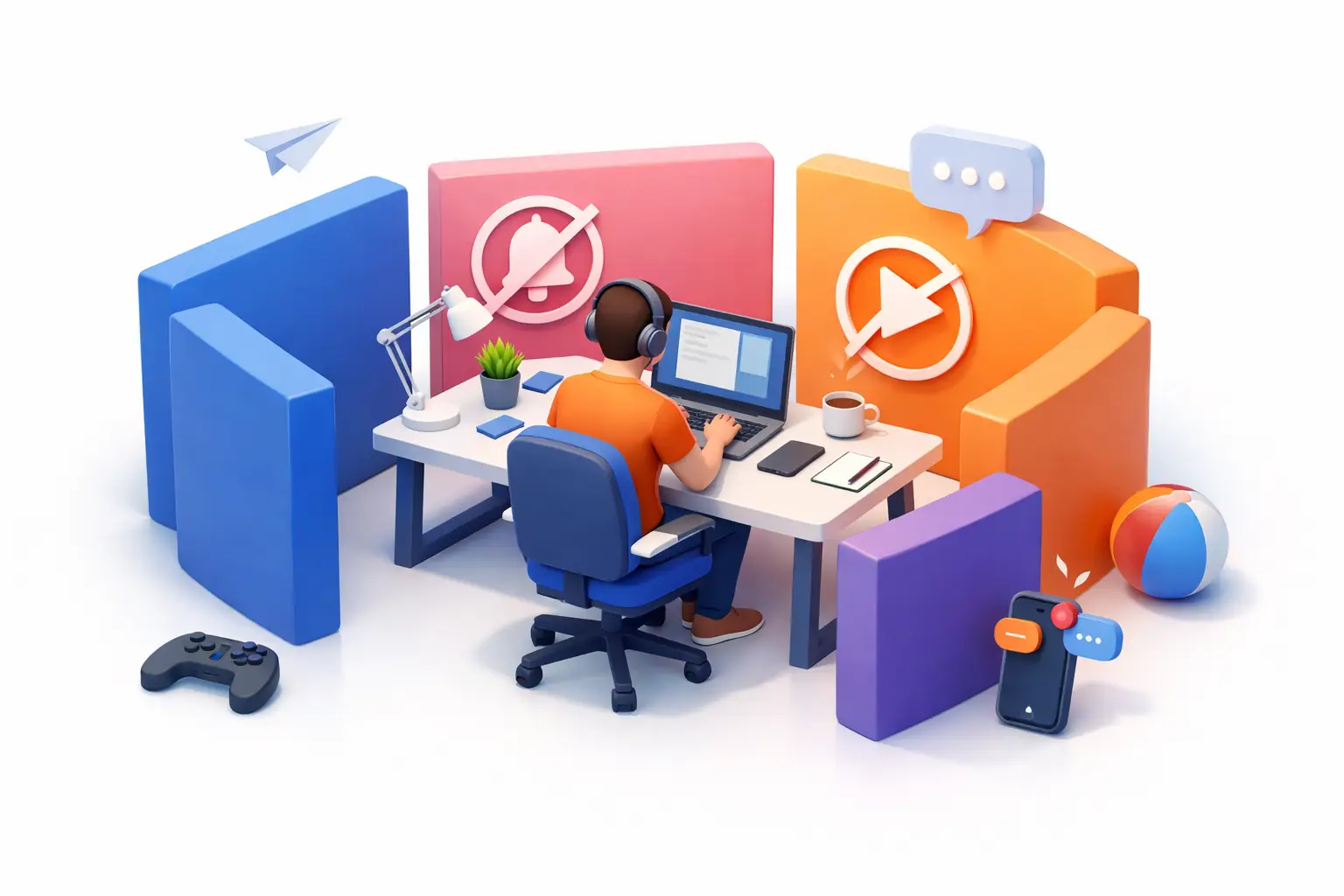
You do not lose a workday all at once. You lose it in fragments - one glance at a text, one tab switch, one "quick check" that turns into ten minutes gone. If you want to learn how to create distraction free work blocks, stop thinking about motivation and start thinking about control. Focus is rarely a mood. It is a setup.
A good work block is not just time on your calendar. It is protected time with rules. You decide what you are doing, how long you are doing it, and what you will not touch until the block ends. That is the difference between hoping to focus and actually getting focused work done.
What distraction-free work blocks actually are
A distraction-free work block is a fixed period of time dedicated to one specific activity with clear boundaries around your attention. Usually that means one task, one timer, and zero phone interaction until the session ends.
The key word here is block. Not vague work time. Not "I should probably make progress on this." A block has edges. It starts. It ends. You can measure it. You can repeat it.
This matters because most people do not fail at productivity from laziness. They fail from leakage. Attention leaks into notifications, messages, email, music changes, browser wandering, and low-grade mental clutter. By the time they sit down to work, they are already half gone.
How to create distraction free work blocks that hold up
The biggest mistake is making the block too ambitious. If you tell yourself you are about to do three hours of perfect deep work, your brain will negotiate its way out before you begin. Start smaller and stricter.
Pick one task. Not a category like "marketing" or "studying." Name the actual action. Write the client proposal. Outline section two. Review lecture notes for chapter five. Specific work is easier to enter because there is less resistance at the start.
Then set a duration you can honestly protect. For most people, 25 to 50 minutes is the right range. Short enough to feel doable. Long enough to matter. If your attention is currently wrecked by constant phone checking, begin with 20 or 25 minutes. Build from there.
Next, define your non-negotiables. During the block, you do not check texts. You do not touch your phone. You do not "just quickly" open social media. You do not switch tasks because the current one got uncomfortable. The point is not to feel free. The point is to stay locked in long enough to make progress.
Finally, make the session visible. A timer matters because it creates a contract. The clock is running. The block is real. This is one reason timer-based systems work so well. They remove the need to keep re-deciding whether you are still working.
Your phone is the first problem to solve
If you are serious about creating distraction-free work blocks, your phone cannot stay in reach as a willpower test. That setup is weak. You are asking a device designed to steal attention to sit beside you quietly while you ignore it. Bad plan.
Put it face down and out of reach at minimum. Better, place it across the room. Best, start a focus session and leave it alone until the timer ends. The physical separation matters more than people want to admit. When the phone is near you, part of your brain stays available to it.
This is where simple systems beat complicated productivity stacks. You do not need twelve settings, three browser extensions, and a new notebook method. Start a timer. Put your phone down. Finish the block. That behavior, repeated enough times, changes more than another app full of good intentions.
If you use Apple devices, a tool like Tupp fits this approach because it keeps the session visible without pulling you into more interaction. You start the session, see it on your lock screen, Apple Watch, or widgets, and get honest credit for work you actually completed. That is useful because focus gets stronger when tracking reflects behavior, not guesses.
Build the block before it starts
Most work blocks fail before minute one. The task is unclear, the materials are scattered, and your brain senses friction. So it looks for escape.
Reduce setup cost. Open the document you need. Close the tabs you do not. Put water nearby. Write down the one outcome that would make the block a win. Then begin.
This is not about creating a perfect ritual. It is about removing excuses. A clean start lowers resistance. When the environment is ready, your only job is to work.
There is a trade-off here. Too little preparation creates chaos. Too much preparation becomes another form of procrastination. If you are color-coding folders and rearranging your desk for fifteen minutes before every session, you are decorating avoidance. Keep prep tight.
Choose the right length for the work
Not every task needs the same block length. Administrative work can often fit into 20 or 25 minutes. Writing, coding, analysis, or studying hard material may need 45 to 60. The wrong duration creates unnecessary friction.
Short blocks are underrated. They help you start when energy is low and build trust with yourself. They are also useful if you are returning to focused work after weeks of fragmented attention. A clean 25-minute session is better than a broken 90-minute one.
Longer blocks have value too, but only when your attention can support them. If you keep reaching for stimulation at minute 30, do not romanticize longer sessions. Earn them. String together several shorter blocks first.
The right question is not, "What is the ideal focus block?" It is, "What block can I repeat four times this week without breaking the system?" Consistency beats intensity.
What to do when your mind wanders
It will wander. Expect it. The goal of a distraction-free block is not perfect concentration every second. The goal is no voluntary escape.
When you notice your attention drift, bring it back to the task without drama. Do not turn a normal lapse into a story about having no discipline. Just return. That reset is part of the reps.
If the urge to check your phone is strong, note it and keep going. Most urges fade faster than you think when they are not rewarded immediately. What weakens focus is not the urge itself. It is obeying it.
This is why clear session rules matter. If your rule is "I should try not to get distracted," you will negotiate. If your rule is "I do not touch my phone until the timer ends," there is less room for nonsense.
Use breaks without losing momentum
Breaks matter, but sloppy breaks kill the next block. If you finish a session and instantly open social media, you are feeding the exact habit you are trying to control.
Keep breaks simple. Stand up. Walk. Stretch. Get water. Look outside. Let your attention reset without dropping into an algorithm.
This does not mean every break needs to feel monk-like. It means your break should support the next block instead of sabotaging it. A five-minute reset is useful. A five-minute scroll is rarely five minutes and almost never neutral.
Track blocks, not intentions
A lot of people feel productive because they planned well. That is not the same as working well. The fix is brutally simple: track completed blocks.
When you measure sessions by activity and by day, patterns become obvious. You see when your focus is strongest. You see where your week gets hijacked. You see whether you are actually doing the work you claim matters.
This kind of tracking also keeps your standards honest. "Worked on project" is vague enough to hide inside. "Completed three 30-minute writing blocks" is real. It happened or it did not.
There is another benefit. Tracking turns focus into a habit loop. You start associating progress with visible completed sessions rather than mood, inspiration, or guilt. That shift matters. It makes disciplined work feel concrete.
Make work blocks part of your week
One good focus session is nice. A repeatable system is better. Put work blocks where they belong in your week instead of waiting for random free time.
That might mean two blocks before checking email, one block after class, or a focused hour before client work gets reactive. The schedule depends on your life, but the principle stays the same: decide in advance.
Be realistic. If your afternoons are full of meetings, stop pretending your deepest work will happen then. Protect mornings. If your energy is unreliable, shorten the blocks and increase frequency. The best system is not the most intense one. It is the one you keep.
Start with a standard you can hold. One block a day is enough to change your week if it is real. Once that becomes normal, add more.
Distraction-free work is not built by chasing perfect conditions. It is built by making fewer decisions, setting harder boundaries, and keeping score. Start one timer today. Put your phone down. Let the block do its job.
 Download on the App Store