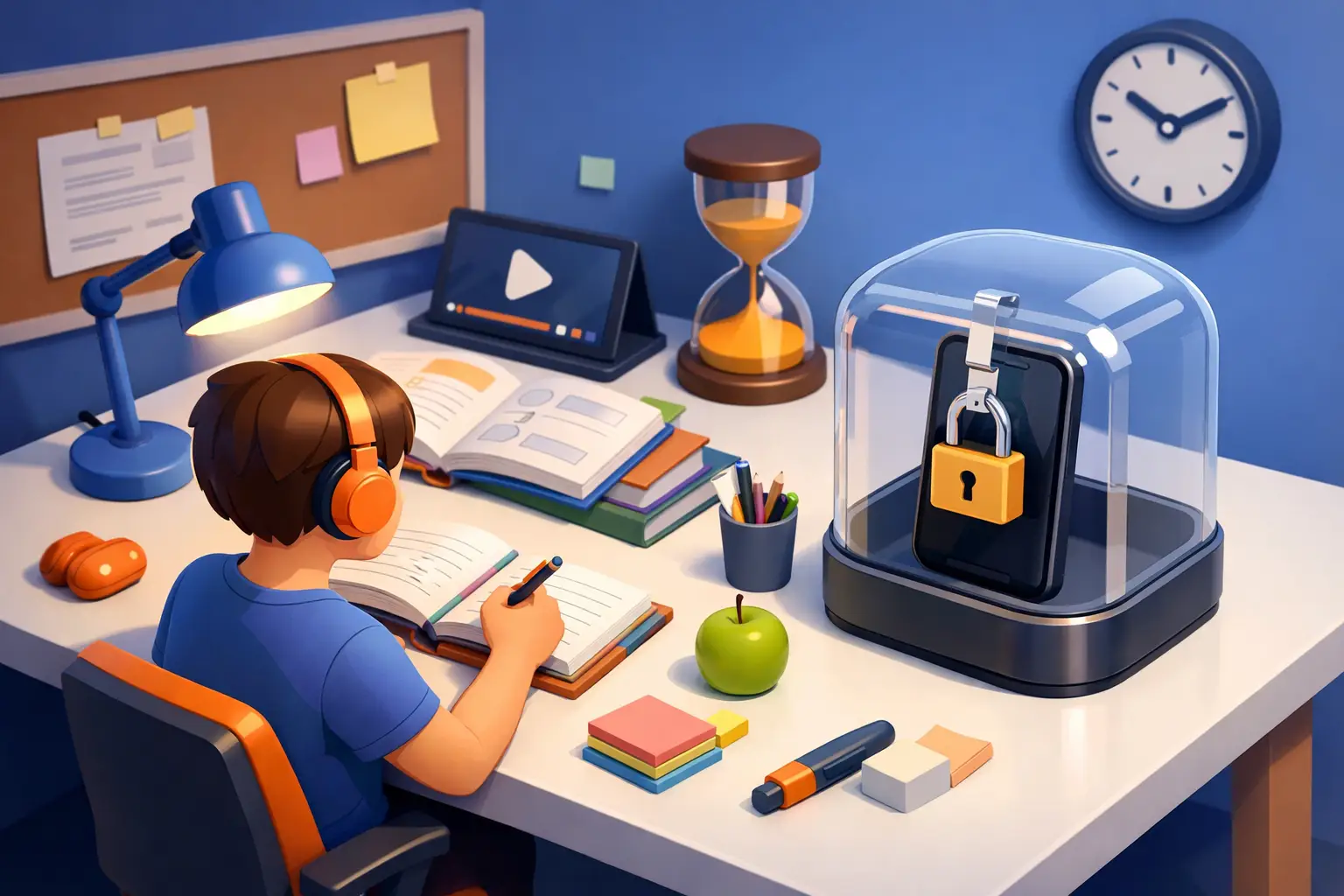
You sit down to study for an hour. Twenty minutes later, your notes are open, your laptop is idle, and your phone has somehow convinced you that checking one text turned into Instagram, email, and a random video you did not need. If you want to know how to stay off your phone while studying, stop looking for more willpower. Build a setup that makes distraction harder than focus.
That matters because your phone is not just one distraction. It is a stack of them. Messages, group chats, short-form video, breaking news, sports alerts, and the reflex to check the lock screen every few minutes. Studying against that with good intentions alone is a losing game.
The fix is simpler than most people make it. Set rules before you start. Reduce access. Track real study sessions. Repeat the pattern until it becomes automatic.
Why your phone keeps beating your study plan
Most students assume the problem is discipline. Sometimes it is. More often, the problem is friction in the wrong place.
Right now, your phone is easy to reach, easy to justify, and built to interrupt you. Studying is the opposite. It asks for delayed payoff, mental effort, and sustained attention. When your brain gets tired, it takes the easier option.
That is why vague goals fail. “I’ll try not to check my phone” is not a rule. It is a suggestion. Suggestions lose when your attention drops.
A real rule sounds different. “For the next 45 minutes, my phone stays face down across the room and I do not touch it until the timer ends.” That is clear. You either did it or you didn’t.
How to stay off your phone while studying
Start with one principle: remove decisions during the session.
If you keep renegotiating with yourself, you will lose time. You will tell yourself you are checking the time, then a notification appears, then your focus is gone. The best study systems cut off the debate before it starts.
Use a timer, not a promise
A study block should have a start and an end. Without that, your brain treats the task like open-ended punishment.
Set a timer for a block you can actually finish. For most people, 25 to 50 minutes works. If your attention is weak right now, start with 25. If you are preparing for exams and already have decent focus, go longer.
Then follow one rule: once the timer starts, the phone is off-limits until it ends.
This is where a session-based system works better than motivation. Start a timer. Put your phone down. Finish the block. You are not trying to become a new person in one afternoon. You are completing one clean session.
Put the phone out of reach
Do not keep it on the desk. Do not keep it in your lap. Do not put it screen-down next to your notebook and pretend that counts.
Distance matters. If your phone is within arm’s reach, checking it stays effortless. Put it on a shelf, in a backpack, in a drawer, or in another room. If you need your phone for emergency calls, keep calls enabled but move everything else out of sight.
The goal is not to prove you are strong. The goal is to make bad decisions slower.
Turn off the triggers
Notifications are study killers because they create unfinished business in your head. Even if you do not open the message, part of your attention is gone.
Before a study block, turn on Do Not Disturb. Better yet, create a focus mode that allows only true emergencies. Mute group chats. Remove social apps from your home screen. Disable badges if those little red circles pull you in.
You do not need a dramatic digital detox. You need fewer triggers between now and the end of the session.
Build a study environment that does not invite relapse
Your environment either supports focus or leaks it.
If you study in bed with your phone next to you, you are making the session harder than it needs to be. If you study at a desk with your materials ready, water nearby, and your phone physically removed, you lower resistance.
Small changes count. Open only the tabs you need. Keep your charger away from your study spot if plugging in your phone becomes an excuse to handle it. Use full-screen mode on your laptop when possible. If one device pulls you off task, strip it down before the session starts.
This is boring advice. It also works.
Make your study blocks specific
A lot of phone use starts when you hit ambiguity.
You tell yourself you are going to “study biology,” then realize you are not sure where to begin, so you check your phone for a minute. That minute becomes ten.
Be more precise. Decide the exact target before the timer starts. Read pages 42 to 58. Complete 20 practice problems. Rewrite lecture notes for chapter 3. Create flashcards for one unit.
Specific work reduces drift. Drift is when your phone wins.
Match the block length to the task
Not every subject needs the same study rhythm. Reading-heavy work may fit well into 30-minute blocks. Problem-solving might need 45 or 60 if it takes time to get into it. Memorization may benefit from shorter, repeated rounds.
Do not force a trendy method onto every task. Use a block length that gives you enough time to make progress without burning out. If you keep failing at 60 minutes, that is not a character flaw. It means your block is too long for your current focus level.
Track what you actually did
This is where most students stay soft on themselves. They remember how busy they felt, not how long they actually studied without touching the phone.
Track completed sessions by subject or activity. Not planned sessions. Completed ones.
That difference matters. Honest tracking shows patterns fast. You may think evenings are your best time, but your data may show your phone pulls you off task after 8 p.m. You may think you studied four hours yesterday, but clean focus time was closer to two.
That is not bad news. It is useful news.
A timer-based workflow helps because it turns focus into a visible behavior. One session finished. Then another. If you use a tool like Tupp, the structure stays simple: start a session, leave the phone alone, and let the timer hold the line. Over a week, you can see whether your study habits are real or just well-worded intentions.
What to do when you slip mid-session
You probably will. The goal is not perfection. The goal is a fast recovery.
If you grab your phone during a study block, do not waste the next fifteen minutes feeling guilty. End the interruption quickly and restart the rule. If the slip was small, put the phone back and continue. If you fully broke the session, reset the timer and begin again.
What matters is how little drama you add.
A lot of people turn one mistake into a lost evening. They check their phone once, decide the session is ruined, and drift for another hour. That is weak thinking. Break the spiral early.
When you actually need your phone for studying
Sometimes your phone is not optional. You may need it for two-factor authentication, a class app, recorded lectures, or flashcards.
In that case, separate study use from entertainment use as much as possible. Open the one app you need and close everything else. Use focus mode. Turn on grayscale if color-heavy apps tempt you. Keep the phone standing up across the desk instead of in your hand. Better yet, move any essential study function to your laptop or tablet when possible.
If your phone has to stay in the workflow, your rules need to get tighter, not looser.
The real goal is not less phone time
The goal is trust.
You want to sit down, start a study block, and know you will follow through. You want evidence that you can control your attention even when your phone is nearby. You want a week of honest sessions you can look at and say, yes, I did the work.
That kind of control does not come from hype. It comes from repetition.
Start smaller than your ego wants. One clean 25-minute block is better than a fake two-hour study session full of phone checks. Stack enough clean blocks and your attention gets stronger. More important, your standards get stronger.
Your phone is not going to become less distracting on its own. So stop negotiating with it. Set the timer. Put it down. Earn the session. That is how studying starts to feel solid again.
 Download on the App Store