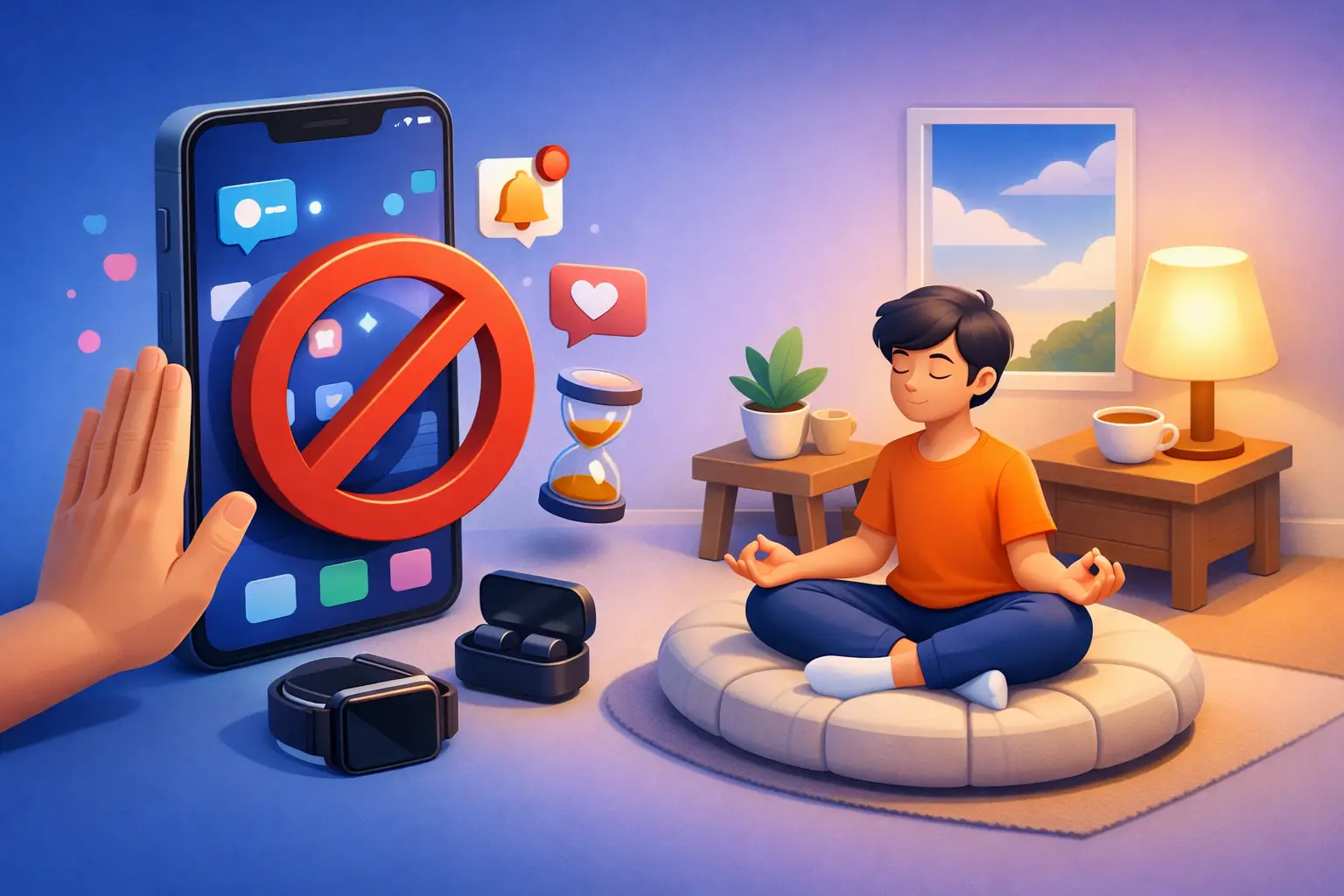
You don’t check your phone because you need it every five minutes. You check it because your brain learned that a quick glance might give you something - relief, novelty, validation, distraction. If you want to learn how to stop checking phone constantly, stop treating it like a bad habit you should feel guilty about and start treating it like a behavior loop you can interrupt.
That shift matters. Shame makes you reactive. Systems make you consistent.
Why you keep checking even when you don’t want to
Most people think the problem is weak willpower. Usually it’s weaker friction. Your phone is close, bright, personalized, and built to reward checking. It sits next to your hand like an open tab for your attention.
The check itself is often tiny. Unlock. Swipe. Nothing urgent. Lock it again. But the cost is bigger than it looks. Each glance breaks continuity. You have to re-enter the task, rebuild context, and fight the urge to check again a few minutes later. That’s why a day can feel busy while very little meaningful work gets done.
There’s also a difference between necessary phone use and compulsive phone checking. If your job depends on messages, calendars, or two-factor logins, the answer is not to pretend your phone doesn’t exist. The answer is to separate intentional use from reflexive use.
How to stop checking phone constantly: fix the cue, not just the urge
If your phone is always visible, always buzzing, and always available, you will keep checking it. You need fewer triggers, not more motivation.
Start with physical distance. Not symbolic distance. Real distance. Put the phone across the room, in a drawer, or in your bag. If it stays face up beside your keyboard, you’re negotiating with a slot machine.
Next, kill the visual noise. Turn off non-essential notifications. Remove badges from apps that don’t deserve your attention. Use grayscale if color hooks you. Move your most compulsive apps off the home screen or remove them entirely for a while. Make checking slightly annoying. That small increase in friction matters.
Then deal with your weak moments before they happen. Most people check during transitions: before starting work, between tasks, while waiting, during any moment of mental resistance. That means the goal is not just “don’t check.” The goal is to replace the checking moment with a defined action.
When you feel the urge, your replacement can be simple: take one breath, write the next step, and continue. Or stand up, stretch, and sit back down. Or note the urge and wait 60 seconds. You’re teaching your brain that discomfort does not require a screen.
Use a timer because discipline works better with boundaries
This is where most advice gets soft. “Be more mindful” is fine. It’s just not enough when your attention is already fragmented.
A timer gives your focus a clear container. Start a session. Put the phone down. Don’t touch it until the timer ends. No decisions in the middle. No constant self-negotiation. That’s the point.
This works because it turns an abstract goal into a visible rule. You are not trying to be a better person for the rest of the day. You are protecting the next 25 minutes, or 45, or 60. Short enough to start. Clear enough to follow.
If that still feels hard, shrink the session. Ten clean minutes is better than 45 minutes of cheating. Build evidence first. Then build duration.
A timer-based system also exposes reality. You stop telling yourself you “worked most of the afternoon” when you actually checked your phone every six minutes. Honest sessions beat vague effort.
Build a phone rule that survives real life
You do not need a perfect digital detox. You need rules that hold under normal stress.
Make them specific. “Use my phone less” is useless. “I only check messages at 11:30, 2:00, and 5:00” is usable. “My phone stays off my desk during focus sessions” is usable. “Social apps stay deleted Monday through Friday” is usable.
The best rule depends on your life. If you’re a freelancer managing clients, rigid no-phone blocks may be unrealistic during parts of the day. Use shorter focus sessions and scheduled check windows. If you’re studying or doing deep creative work, longer protected blocks make more sense. If you’re a parent or on-call worker, priority contacts may need an exception. Fine. Exceptions are not failure. Undefined access is.
You want a rule that removes debate. The more often you ask, “Should I check really quick?” the more often you will.
Change your environment before you try to change your personality
Your environment is either training compulsive checking or training control.
Keep chargers away from your main workspace if charging invites browsing. Don’t bring your phone into bed if nights disappear into scrolling. Use a real alarm clock if the first thing you do every morning is grab your phone and fall into feeds before your feet hit the floor.
Watch for cue stacking. If coffee means phone, couch means phone, bathroom means phone, elevator means phone, your surroundings are full of learned prompts. Break the pairing. Drink coffee without it. Take a walk without it. Wait in line and do nothing for 30 seconds. Boredom is not an emergency.
This part feels small, but it changes your baseline. The less often your phone is woven into every idle second, the less automatic checking becomes.
Track behavior, not intentions
People are terrible at estimating their own focus. They remember the good hour and forget the scattered two.
Track sessions instead. Track how long you worked without touching the phone. Track what activity you were doing. Track how often you broke your own rule. Once you can see the pattern, you can fix the pattern.
This is where a simple tool matters more than a complicated one. If logging focus takes too much effort, you won’t keep doing it. A timer-first system like Tupp works because it keeps the rule blunt: start a session, put the phone down, finish what you said you were doing. You can see active sessions across your devices and review what actually happened during the week. That kind of visibility cuts through excuses fast.
The weekly view matters. One bad afternoon means nothing. A week of broken sessions tells the truth. Maybe your mornings are strong and your late afternoons collapse. Maybe one project holds attention and another sends you reaching for your phone every few minutes. Good. Now you have something to work with.
Expect withdrawal, not instant freedom
If you’ve been checking your phone dozens or hundreds of times a day, reducing that behavior will feel uncomfortable at first. That’s normal.
You may feel phantom vibrations. You may feel behind, even when nothing urgent is happening. You may sit down to work and suddenly want to check weather, email, sports, headlines, messages, and one random fact that absolutely cannot wait. That’s not a sign your system is failing. That’s the habit pushing back.
Don’t dramatize it. Notice the urge. Keep the rule. Finish the session.
This gets easier when you stop expecting focus to feel smooth. Sometimes focus feels clean. Sometimes it feels like not giving in. Both count.
If you relapse, tighten the system
A bad day does not mean you lack discipline. It usually means your setup got loose.
If you keep checking during work, increase distance. If you keep checking from boredom, shorten your session and stack them. If notifications pull you back in, turn off more of them. If social apps are the problem, make access harder than one tap. If evenings are a mess, create a shutdown time and physically park the phone away from where you relax.
The question is not, “Why am I like this?” The question is, “What made checking easy today?” Answer that honestly and adjust.
You do not beat compulsive phone checking with one big promise. You beat it with repeated proof that your attention belongs to you. Start small. Make the rule clear. Start the timer. Put the phone down. Then let the session do its job.
 Download on the App Store