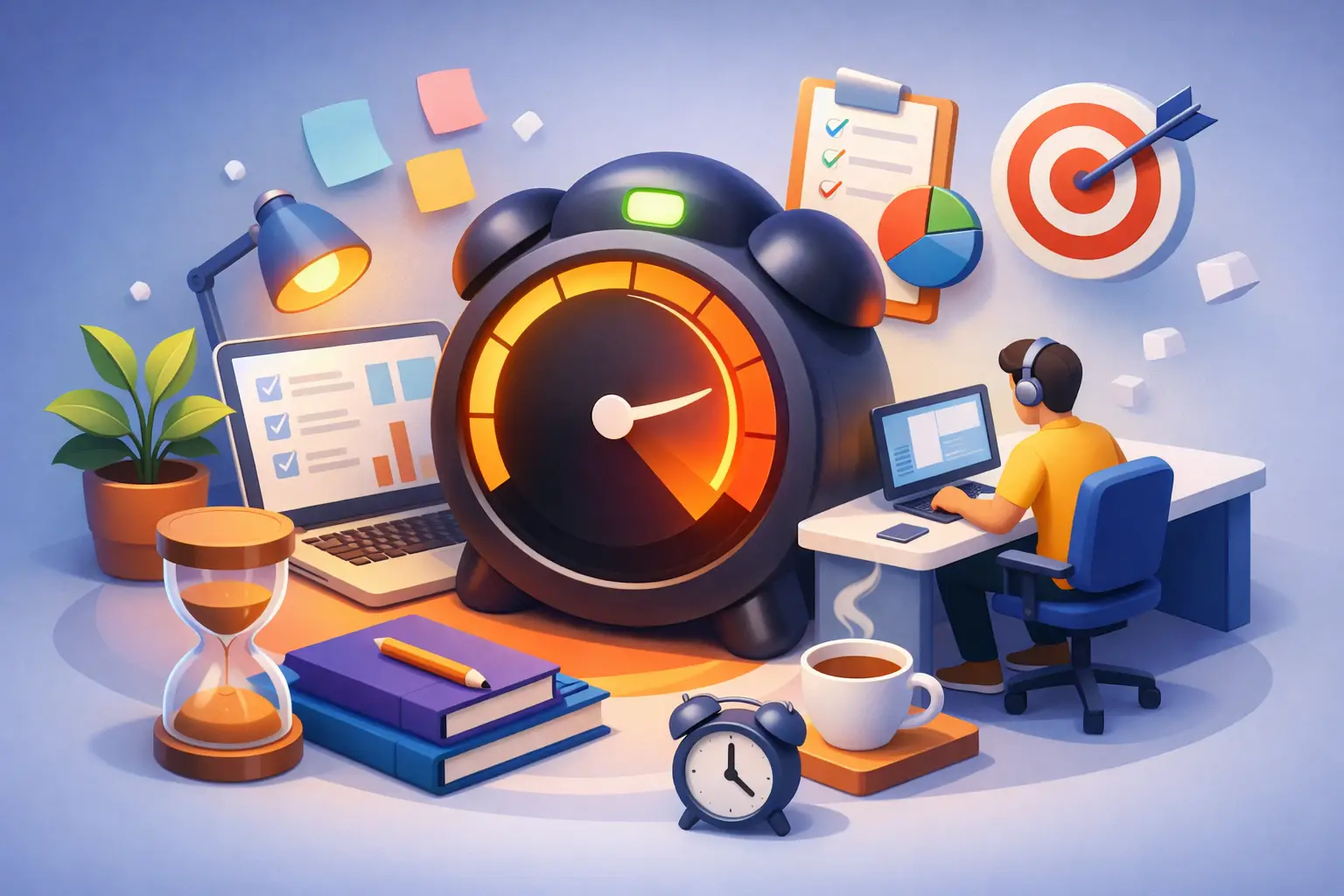
You do not need another productivity trick. You need a focus timer that changes your behavior in the moment you usually break focus - when your phone lights up, your attention slips, and one quick check turns into twenty minutes gone.
That is the real job of a focus timer. Not to look nice on a screen. Not to gamify your day with fake progress. Its job is simple: start a session, commit to one task, and keep your hands off the distraction machine until the timer ends.
If that sounds basic, good. Focus usually breaks in basic ways. The fix should be just as clear.
What a focus timer actually does
A focus timer puts boundaries around your attention. You choose the work, set the session length, and let the clock create a rule you follow. Until the session ends, you stay with the task.
That structure matters more than most people admit. A lot of lost time does not come from giant failures of discipline. It comes from tiny permissions. Check one text. Open one tab. Look at one notification. Reset your mental context. Try to get back into the work. Repeat all day.
A timer interrupts that pattern. It creates a short contract with yourself. For the next 25 minutes, or 45, or 60, you are doing this and not that.
Used well, a focus timer turns work from a vague intention into a visible session. That difference is everything. Vague plans are easy to break. Active sessions are harder to ignore.
Why most focus systems fail after a week
Most people do not quit because they hate the idea of focus. They quit because the system adds friction.
If starting a session takes too many taps, if tracking feels like admin work, or if reviewing your progress is buried in charts nobody wants to open, the habit dies fast. The tool becomes another task.
That is why simple beats clever. The best focus timer is the one you can start immediately and see constantly. It should stay visible without demanding more attention than the work itself. It should support discipline, not become its own form of distraction.
There is another problem too. A lot of tools track what you planned to do, not what you actually did. Those are not the same thing. You can build a beautiful schedule and still spend half the day reacting to messages. Honest tracking starts with sessions completed, by activity and by day. Anything softer leaves room for self-deception.
The best focus timer is built around behavior
A timer by itself is not magic. If you can start it and then scroll through social media with the countdown running, you are not focusing. You are decorating distraction.
A useful system changes the behavior around the timer. Start the session. Put the phone down. Leave it alone until the session ends. That is where the value is.
This sounds strict because it is. Focus requires friction against impulse. If the same device that holds your timer also gives you fast access to entertainment, messages, and novelty, then your workflow has to reduce the chance of wandering off.
That is why visibility matters. A timer that stays on your lock screen, your watch, your widgets, or your desktop makes it easier to respect the session without poking around inside an app. You should be able to check progress without opening the door to distraction.
For Apple users, this matters even more. Your phone is always near you. The best setup does not pretend that reality away. It uses the devices you already carry, but in a controlled, low-friction way.
How to use a focus timer without overthinking it
Start with one rule: match the session length to the task, not to some internet-approved number.
Short work that feels annoying or easy to postpone often benefits from a 15 to 25 minute block. It lowers resistance. You are not promising your whole afternoon. You are just starting.
Work that requires real concentration, like writing, studying, coding, or analysis, often needs 45 to 90 minutes. Too short, and you spend most of the session warming up. Too long, and your attention gets sloppy.
This is where people get stuck. They look for the perfect interval instead of building consistency. Do not do that. Pick a length you can honor today. Then repeat it tomorrow.
It also helps to label the session by activity. Not because labels are exciting, but because memory is unreliable. At the end of the week, you want to know where your time actually went. Deep work. Admin. Study. Reading. Training. Client work. If everything is dumped into one generic category, your data will be less useful than your guess.
Focus timer habits that hold up in real life
The strongest focus habits are boring on purpose. They reduce decisions and make the next action obvious.
Start sessions at the same points in your day. After coffee. At the start of your work block. Right after lunch. Before checking email. Attach the timer to existing routines so focus becomes automatic instead of aspirational.
Keep your session startup tight. Choose the task. Set the timer. Put the phone down. Begin. If there are too many setup steps, you create space for avoidance.
Review your week, not just your mood. Some days feel productive and are not. Other days feel messy but contain three solid hours of real focus. Session history cuts through the story you tell yourself.
This is where a tool like Tupp fits naturally. It keeps the workflow strict and visible across iPhone, Apple Watch, lock screen, widgets, and web, so the timer supports the habit instead of competing with it. That cross-device visibility is not a gimmick. It helps you stay accountable without adding more screen friction.
What to look for in a focus timer
Not every timer deserves a spot in your routine. Some are too bare to be useful. Others are packed with features that quietly pull attention away from the work.
Look for a focus timer that makes starting fast. You should not need a tutorial to begin a session. It should also make the active session visible from wherever you are. If you need to reopen the app every time you want reassurance, the tool is already asking for too much.
Tracking should be session-based and honest. You want records of completed work by activity and by day. Weekly patterns matter. One good Tuesday does not tell you much. Four weeks of consistent sessions do.
Analytics help, but only if they answer practical questions. Which activities get your best hours? Which days collapse into reactive work? Where are you consistent, and where are you lying to yourself? If the numbers do not change your next week, they are decoration.
A final point: the right tool should feel disciplined, not punishing. Friction is useful when it blocks distraction. It is useless when it makes legitimate work harder to start.
When a focus timer is not enough
Sometimes the timer is not the issue. The task is unclear, the environment is noisy, or your energy is shot.
A focus timer cannot fix work you have not defined. If you start a 45-minute session with a vague goal like work on project, your brain will look for escape routes. Specific tasks hold attention better. Draft the intro. Review chapter three. Clear the invoice backlog. Make the task concrete.
It also cannot erase context switching forced by your job. If you are in a reactive role, long uninterrupted sessions may not be realistic every day. That does not make the timer useless. It means you should use shorter blocks and judge success by consistency, not fantasy.
And yes, rest matters. If every session feels impossible, the answer may not be more discipline. It may be sleep, food, or a walk. Honest productivity includes limits.
The real payoff of using a focus timer
The immediate win is obvious: less scrolling, more work done.
The bigger payoff is trust. You stop ending the day with a blurry sense that you were busy but are not sure what happened. You get proof. You can see the sessions, the categories, the pattern of your week. That changes how you plan, how you work, and how honestly you judge your effort.
That is why a focus timer matters. It is not just a countdown. It is a small system for keeping promises to yourself.
Start the session. Put the phone down. Let the timer tell the truth about your day.
 Download on the App Store